JUSTIFICATION & SANCTIFICATION
And such some of you were; but you are washed, but you are sanctified,
but you are justified in the name of our Lord Jesus Christ,
and the Spirit of our God.
1 Corinthians 6, 11
The text from 1 Corinthians 6:11 is part of a letter written by the Apostle Paul to the early Christian community in Corinth. In this verse, Paul addresses certain behaviors and lifestyles characteristic of the people before they became followers of Christ. The phrase “And such some of you were” acknowledges their past misdeeds, which included various sinful behaviors.
The terms “washed,” “sanctified,” and “justified” are theological concepts that express the transformative work of Jesus Christ in the lives of believers. Being “washed” signifies a cleansing from sin. In Christian belief, accepting Jesus brings about forgiveness and purification, allowing individuals to start anew, free from the guilt of their previous actions.
Being “sanctified” refers to being set apart or made holy. It signifies the process of growing in holiness and moral purity, as believers are called to live in ways that reflect their new identity in Christ. Being “justified” indicates being declared righteous in the sight of God. Justification is understood as a legal declaration whereby believers are deemed righteous by faith in God, rather than through their own natural efforts or deeds.
The phrase “in the name of our Lord Jesus Christ, and the Spirit of our God” emphasizes that this transformation is initiated and accomplished through the Lord Jesus and the work of the Holy Spirit. Overall, this text reassures believers of their new identity and status in Christ, affirming that through Him, they have been changed and are called to live differently.
The passage from 1 Corinthians 6:11 highlights a transformative journey for believers, emphasizing being washed, sanctified, and justified in the name of Jesus Christ. In Catholic teaching, this text is closely linked to the sacrament of Baptism, which plays a central role in the spiritual life of Catholics. In Catholic theology, Baptism is the sacrament of initiation that cleanses a person of original sin. This “washing” symbolizes the purification of the soul and the beginning of a new life in Christ. The act of baptism is not only a physical washing with water but also a spiritual renewal, wherein the individual is cleansed from sin and reborn into the family of God.
Sanctification refers to the process of being made holy. Through Baptism, Catholics believe that individuals receive the grace of the Holy Spirit, which empowers them to live a life in accordance with God’s will. This grace is crucial to the journey of sanctification, guiding believers toward a deeper union with God and fostering their growth in virtue and holiness throughout their lives. On the other hand, justification in Catholic teaching refers to being made righteous in God’s sight. Baptism plays a key role in this process, as it not only forgives sin but also grants the baptized a share in God’s divine life. This justification is not a one-time event but an ongoing process that involves cooperation with God’s sanctifying grace through faith and good works in love.
St. Paul often uses the terms justification and sanctification interchangeably, suggesting a close relationship between the two concepts (Heb 13:12; Rom 5:9; 2 Thess 2:13; 1 Cor 6:11). To gain a deeper understanding of how justification and sanctification coexist in the apostle’s theology, it’s helpful to examine the metaphysical framework proposed by the ancient Greek philosopher Aristotle. He introduced the four causes that explain the existence of all created things: efficient, material, formal, and final. In this context, formal causality is particularly relevant, especially in light of the Council of Trent’s definition of sanctification as “the single formal cause (causa formalis) of justification.”
The Council of Trent, held in the 16th century, was a significant event in the Catholic Church’s response to the Protestant Reformation. One of its key teachings concerned sanctification and justification. The Council defined sanctification as the “single formal cause of justification,” meaning that it is the primary means through which people are made righteous before God. In this context, justification is not merely about being declared righteous; it also entails a transformation in a person’s life. The Council emphasized that God’s justice enables this transformation. It is not simply a reflection of God’s inherent righteousness but a means by which people are made just and righteous.
According to the Decree on Justification, particularly in Chapter 7, this divine justice underscores the belief that sanctification is integral to salvation, highlighting that God actively works in people’s lives to make them holy. This teaching sought to clarify the Catholic understanding of God’s grace, faith, and works in the process of salvation, particularly in contrast to certain Protestant views of the time, notably those held by Martin Luther and Jean Calvin, who proposed that the unjust are justified by faith alone.

Thus, the Council of Trent’s Decree on Justification is a key Catholic response to the Protestant Reformation, defining justification not just as pardon but as inner renewal, detailing its causes (God’s mercy, Christ’s merits, Baptism, intrinsic justice) and emphasizing its ongoing process where faith and good works cooperate, not faith alone. It counters Protestant views by emphasizing an inherent righteousness granted by God that increases through virtuous living, making believers truly just, not merely declared so by the imputation of Christ’s external merits to their account (a legal fiction).
The Council’s decree defines justification as the transformation from unjust to just, a sanctification and renewal of the inner person through God’s grace, making one an heir of eternal life. Its Efficient Cause is God’s merciful action, washing and sealing with the Holy Spirit; the Instrumental Cause is the sacrament of Baptism, essential for justification and the remission of original sin; the Formal Cause is God’s justice (sanctification), which makes believers truly just by being made holy in God’s sight; the Meritorious Cause is Jesus Christ’s Passion and satisfaction, and Final Cause: Glory of God and eternal life. Thus, Justification is an ongoing process: it’s a progression, not a single event. Believers advance by cooperating with grace, mortifying sin, and fulfilling God’s commandments, increasing in justice and sanctification.
In Aristotelian metaphysics (4 causes rather than 5, as in Catholic soteriology), the formal cause of any entity encompasses the elements that define its conception or identity, representing the idea of a formative principle interacting with physical matter. In essence, every object or being is made up of both matter and form. The form serves as a determining principle that defines the characteristics of the object, whether it’s an “oak tree” or the concept of justification. Furthermore, the substantial form identifies the species or category to which the entity belongs, thereby differentiating it within a broader classification.
In this metaphysical framework, justification is a crucial concept in God’s design, and it cannot fulfill its intended purpose (final cause) without the determining principle of sanctity. Both justification and sanctification rely on the principle of efficient causality, which holds that an agent brings about a change for a specific purpose. In this framework, grace bestowed by God serves as the material cause, while Divine favor and Divine persuasion, facilitated by the Holy Spirit, represent the efficient cause. The Holy Spirit justifies individuals through His sanctifying grace, which is the formal cause, i.e., sanctification. Consequently, justification and sanctification are interconnected outcomes of the Divine initiative, functioning together like two facets of a single entity to serve the final cause: God’s glory and our reconciliation and eternal communion with Him. As such, neither can effectively exist in isolation within the overarching Divine plan of redemption.
The Council’s 8th chapter (How One is to Understand the Gratuitous Justification of a Sinner by Faith) discusses the theological concept of justification by faith within the framework of Catholic doctrine. It emphasizes the importance of faith in the process of salvation, arguing that faith is the starting point and foundation of justification, the act of being declared righteous before God. This means that having faith in God and His promises is essential for being considered righteous in His eyes (cf. Rom 3:22, 24; Heb 11:6). The term “gratuitously” implies that justification is a gift from God, not something that can be earned through human effort or good works. The text underscores that faith itself, and any actions that come from it, do not merit the grace of justification. Instead, justification is freely given by God’s grace. The reference to works highlights that no amount of good deeds can earn justification. If justification could be earned, then it wouldn’t be a gift; rather, it would be owed to the individual based on their actions. This aligns with the Apostle Paul’s teaching that grace and works are mutually exclusive in the context of salvation—if salvation were achieved through works, it would undermine the nature of grace (cf. Rom 11:6).
Chapter 10 of the Decree on Justification discusses the theological concept of justification by faith within the framework of Catholic doctrine. It emphasizes the importance of faith in the process of salvation, arguing that faith is the starting point and foundation of justification, the act of being declared righteous before God. It begins by affirming that believers, having been justified (declared righteous) by God, become His friends and servants. This relationship is akin to being part of God’s household, which reflects a deep bond and personal connection (cf. Jn 15:15; Eph 2:19).
However, the Council emphasizes that the justified are not static in their faith. Instead, they “advance from virtue to virtue,” suggesting a continual spiritual growth. This growth entails daily renewal, a process of becoming more like Christ through self-discipline and moral living (Ps 83:8; 2 Cor 4:16). Believers are encouraged to “mortify the members of their flesh,” indicating a need to resist sinful desires and behaviors. In doing so, they present their lives as “instruments of justice,” meaning they use their actions to serve God and adhere to His commandments (cf. Col 3:5; Rom 6:13, 19). There is a strong assertion that justification, which is received through Christ’s grace, is not a one-time event but an ongoing process involving both faith and good works. The text emphasizes the importance of cooperation between faith and deeds, as James 2:24 highlights. Throughout, it cites multiple scriptural references supporting the idea that justification can increase through continued faithfulness. These references validate the teachings and demonstrate that they are rooted in scripture, suggesting that believers should strive for continual justification.
Indeed, it is emphasized that our own righteousness—distinct from the external righteousness attributed to Christ—must exceed that of the scribes and Pharisees. This standard is significant, as outlined in Matthew 5:20, which states that entering the kingdom of heaven is contingent upon our inherent righteousness, achieved through the efficacy of sanctifying grace that justifies the soul through the operation of the Holy Spirit, who justifies us by no natural merit of our own but by the merits of Christ. In Romans 5:19, it’s emphasized that our relationship with God undergoes a significant shift, leading to a genuine transformation of our human nature. This transformation is not merely a change in status but involves God making people inherently righteous through the active work of the Holy Spirit. Just as God commanded, “Let there be light,” resulting in actual light (Gen 1:3; cf. Mt 5:14), what God declares as real carries a tangible, objective essence, signifying that His declarations bring about genuine change and reality in individuals’ lives.
The concept of fellowship and purification through Jesus Christ is articulated in 1 John 1:7, which states that if we walk in the light, we can have meaningful connections with one another, and the blood of Jesus cleanses us from sin. Jesus’ mission extended beyond merely atoning for sin; it also included the provision of sanctifying grace, enabling believers to lead holy lives and attain righteousness akin to his own sacred humanity. This righteousness is applied to our lives daily as we cooperate with his saving grace and work in partnership with the Holy Spirit, as referenced in 1 John 3:7. Believers are encouraged to actively engage in the processes of guilt removal and the forgiveness of sins to align with God’s standards of justice. This active participation is essential for salvation and is made possible through the merits of Jesus Christ, who is central to the Christian faith and the key to redemption.
Hence, in Catholic theology, the Holy Spirit plays a crucial role in the justification of the human soul. Justification is understood as the process by which a person is made righteous in the sight of God, primarily through God’s grace. The Holy Spirit is seen as the agent of this grace, working within individuals to transform their hearts and minds. Through the sacraments, especially baptism and confirmation, the Holy Spirit sanctifies believers, marking them as children of God and incorporating them into the body of Christ. During justification, the Holy Spirit enables a person to have faith in Jesus Christ and leads them to repentance. This grace moves the individual to turn away from sin and towards a life of virtue, reflecting God’s love and mercy. The process of justification is ongoing, with the Holy Spirit continually guiding and inspiring the believer to grow in holiness throughout their life.
EARLY SACRED TRADITION
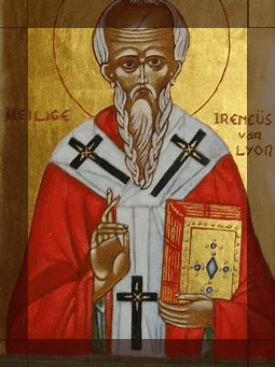
St. Irenaeus, Against Heresies, 5:10,1
(A.D. 180-190)
“So likewise men, if they do truly progress by faith towards better things, and
receive the Spirit of God, and bring forth the fruit thereof, shall be spiritual, as
being planted in the paradise of God. But if they cast out the Spirit, and remain
in their former condition, desirous of being of the flesh rather than of the Spirit,
then it is very justly said with regard to men of this stamp, ‘That flesh and blood
shall not inherit the kingdom of God… …For when men sleep, the enemy
sows the material of tares; and for this cause did the Lord command His disciples
to be on the watch. And again, those persons who are not bringing forth the
fruits of righteousness, and are, as it were, covered over and lost among
brambles, if they use diligence, and receive the word of God as a graft, arrive at
the pristine nature of man–that which was created after the
image and likeness of God.”
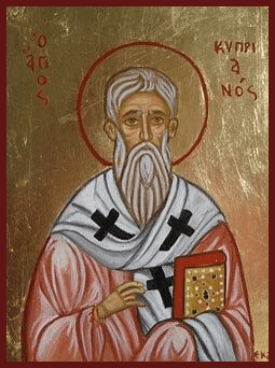
St. Cyprian, On Works and Alms,14
(A.D. 254)
“You are mistaken, and are deceived, whosoever you are, that think yourself
rich in this world. Listen to the voice of your Lord in the Apocalypse, rebuking
men of your stamp with righteous reproaches: ‘Thou sayest,’ says He, ‘I am rich,
and increased with goods, and have need of nothing; and knowest not that thou
art wretched, and miserable, and poor, and blind, and naked. I counsel thee to
buy of me gold tried in the fire, that thou mayest be rich; and white raiment, that
thou mayest be clothed, and that the shame of thy nakedness may not appear in
thee; and anoint thine eyes with eye-salve, that thou mayest see.’ You, therefore,
who are rich and wealthy, buy for yourself of Christ gold tried by fire; that you
may be pure gold, with your filth burnt out as if by fire, if you are purged by
almsgiving and righteous works. Buy for yourself white raiment, that you who
had been naked according to Adam, and were before frightful and unseemly,
may be clothed with the white garment of Christ. And you who are a wealthy
and rich matron in Christ’s Church, anoint your eyes, not with the collyrium of
the devil, but with Christ’s eye-salve, that you may be able to attain to see God,
by deserving well of God, both by good works and character.”
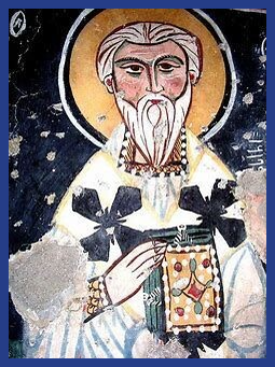
St. Athanasius, Defense of the Nicene Creed, 22
(A.D. 351)
“He from the essence of the Father, nor is the Son again Son
according to essence, but in consequence of virtue,
as we who are called sons by grace.”
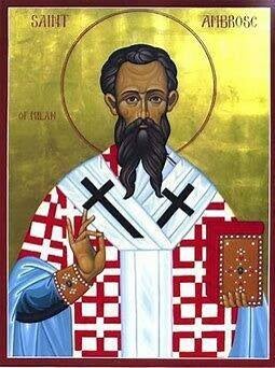
St. Ambrose, Commentary on Luke, 2:84
(A.D. 389)
“You see indeed, then, how the strength of the Lord is cooperative in human
endeavors, so that no one can build without the Lord, no one can preserve
without the Lord, no one build without the Lord, no one can preserve without
the Lord, no one can undertake anything without the Lord.”
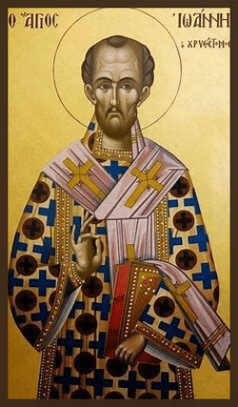
St. John Chrysostom, Romans, Homily Vll: 24, 25
(A.D. 391)
“ ‘To declare His righteousness.’ What is declaring of righteousness? Like
declaring of His riches, not only for Him to be rich Himself, but also to make
others rich, or of life, not only that He is Himself living, but also that He makes
the dead to live; and of His power, not only that He is Himself powerful, but also
that He makes the feeble powerful. So also is the declaring of His righteousness
not only that He is Himself righteous, but that He doth also make them that are
filled with the putrefying sores ‘asapentas’ of sin suddenly righteous.”
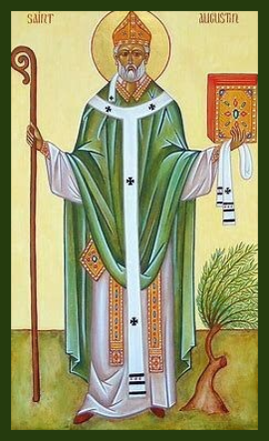
St. Augustine, On the merits and forgiveness of sins, 1:9
(A.D. 412)
“All His saints, also, imitate Christ in the pursuit of righteousness; whence the
same apostle, whom we have already quoted, says: ‘Be ye imitators of me, as I am
also of Christ.’ But besides this imitation, His grace works within us our
illumination and justification, by that operation concerning which the same
preacher of His [name] says: ‘Neither is he that planteth anything, nor he that
watereth, but God that giveth the increase.’ For by this grace He engrafts into His
body even baptized infants, who certainly have not yet become able to imitate
any one. As therefore He, in whom all are made alive, besides offering Himself as
an example of righteousness to those who imitate Him, gives also to those who
believe on Him the hidden grace of His Spirit, which He secretly infuses even into infants…”
For I tell you, that unless your justice abounds more than that of the scribes
and Pharisees, you shall not enter into the kingdom of heaven.
Matthew 5, 20
PAX VOBISCUM
 All About Catholicism